Moissanite 101
Where science meets beauty
The story, the science and the sparkle behind the stone we chose for every BELY piece.
01 — The origin
What is moissanite?
The story of moissanite begins long before it found its place in jewelry.
In 1893, French chemist Henri Moissan discovered tiny crystals inside fragments of a meteorite in Arizona. Initially mistaken for diamonds, the crystals were eventually identified as silicon carbide, a rare mineral that would later bear his name: moissanite.
For many years, natural moissanite remained a scientific curiosity. It is extraordinarily rare in nature and is almost never found in crystals large enough for fine jewelry.
Scientific advancements eventually made it possible to grow moissanite crystals in laboratories, creating gemstone-quality material that could be cut and polished to reveal its remarkable optical properties.
Today, nearly all moissanite used in jewelry is lab-created. It has its own chemical composition, distinctive optical properties, and identity as a gemstone in its own right.
From its discovery in the stars to its place in modern jewelry, moissanite is where science meets beauty.

02 — The stone
What makes it special
Exceptional Brilliance
Moissanite has a higher refractive index than diamond, meaning it bends light more strongly. It also displays remarkable fire — the flashes of rainbow-colored light created when white light is dispersed.
As a result, moissanite can display more pronounced rainbow flashes than a diamond. This is a natural characteristic of the gemstone, not a surface treatment.
Made for Everyday Wear
With a hardness of 9.25 on the Mohs scale, moissanite ranks among the hardest gemstones used in jewelry. It offers excellent scratch resistance, making it a beautiful choice for pieces designed to be worn regularly.
Like any gemstone, however, it deserves proper care to maintain its beauty over time.
Beauty, Created with Precision
Laboratory production allows moissanite crystals to be grown under controlled conditions and cut to showcase their brilliance, color, and proportions.
The result is a gemstone valued for its intrinsic qualities rather than its geological rarity.
- Mohs hardness
- 9.25
- Refractive index
- 2.65
- The fire of a diamond
- 2.4×

FAQ
Your questions, answered
Is moissanite a real diamond?
No. Moissanite and diamond are two different gemstones. Diamond is composed of carbon, while moissanite is composed of silicon carbide.
However, moissanite is a genuine gemstone in its own right, with distinctive optical and physical properties that make it highly desirable for jewelry.
How is moissanite made?
Moissanite is created in a controlled laboratory environment by combining silicon and carbon under precisely regulated conditions. Over several weeks, these elements form crystals with exceptional clarity and consistent quality.
Once grown, each crystal is carefully cut and polished to enhance its brilliance, symmetry, and sparkle. The quality of the cut plays an essential role in how beautifully the stone reflects light.
Each stone is evaluated for key characteristics, including color, clarity, and cut.
A more conscious choice, exceptional brilliance, and quality you can trust.
No mining.
No environmental impact.
No questionable sourcing.
Is moissanite worth it?
Absolutely. Moissanite combines exceptional brilliance, durability, and timeless beauty, making it ideal for everyday luxury.
- Durable: With a hardness of 9.25 on the Mohs scale, moissanite is highly scratch-resistant and suitable for everyday wear.
- Brilliance that lasts: It won't naturally yellow or lose its sparkle. Gentle cleaning helps remove everyday buildup.
- A conscious choice: Lab-grown moissanite offers a beautiful alternative to mined gemstones without the environmental impact of mining the stone itself.
- Accessible luxury: Enjoy exceptional sparkle and quality at a more accessible price than diamonds.
Why does moissanite pass a diamond tester?
Moissanite shares an important characteristic with diamonds: both conduct heat exceptionally well. This is why traditional diamond testers can sometimes identify moissanite as a diamond.
Moissanite also offers remarkable brilliance, excellent durability, and lasting sparkle, making it a high-quality alternative to diamonds.
The takeaway? Moissanite shares many of the qualities that make diamonds desirable, while offering its own distinctive brilliance at a more accessible price.
The BELY standard
Quality you can trust
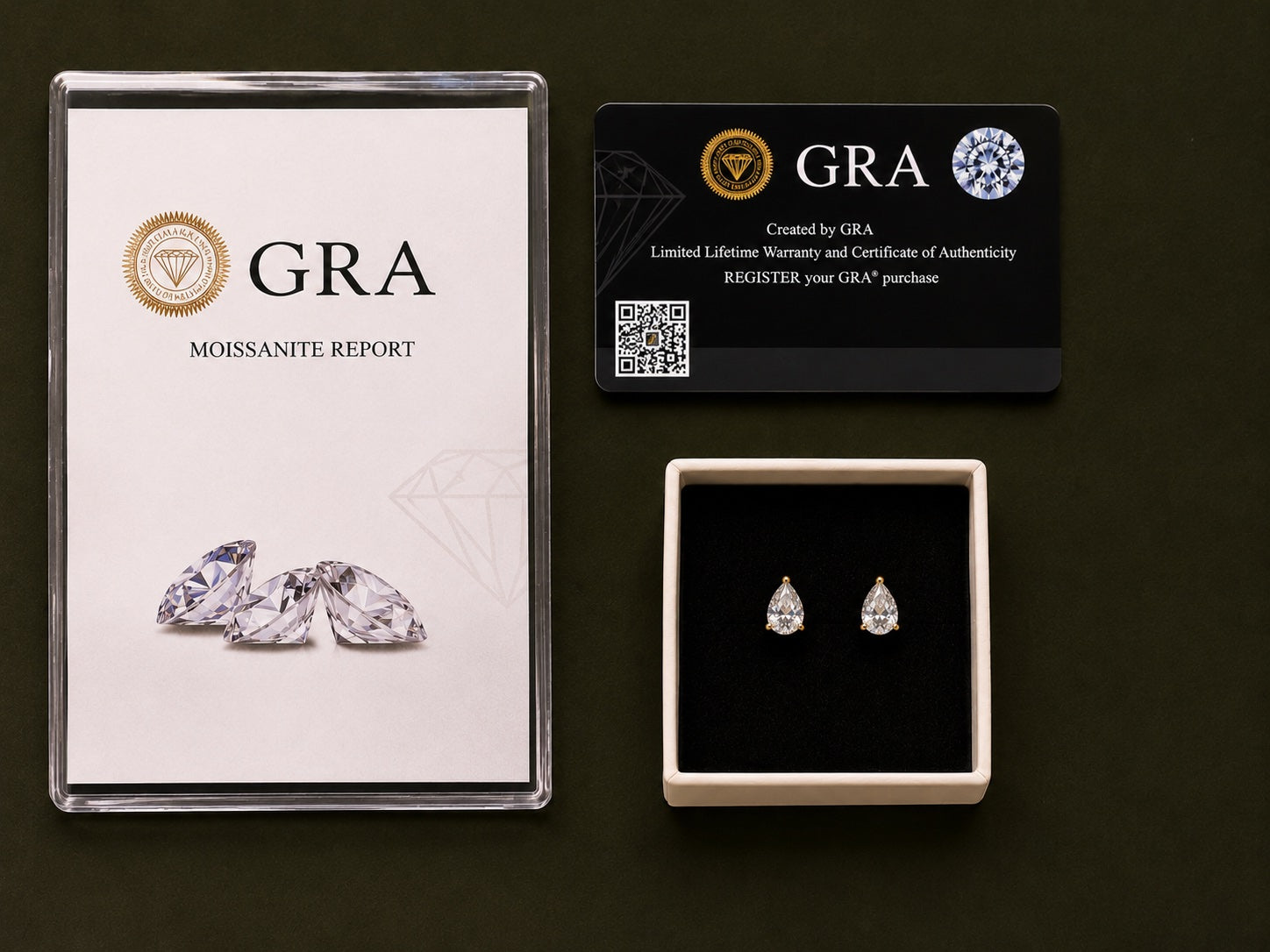
Every BELY moissanite stone features D Color, VVS1 Clarity, and GRA certification, reflecting our commitment to quality and transparency.
Timeless pieces. Exceptional brilliance. Everyday luxury.
- Color
- D
- Clarity
- VVS1
- Certified
- GRA